


The Whole of the Path

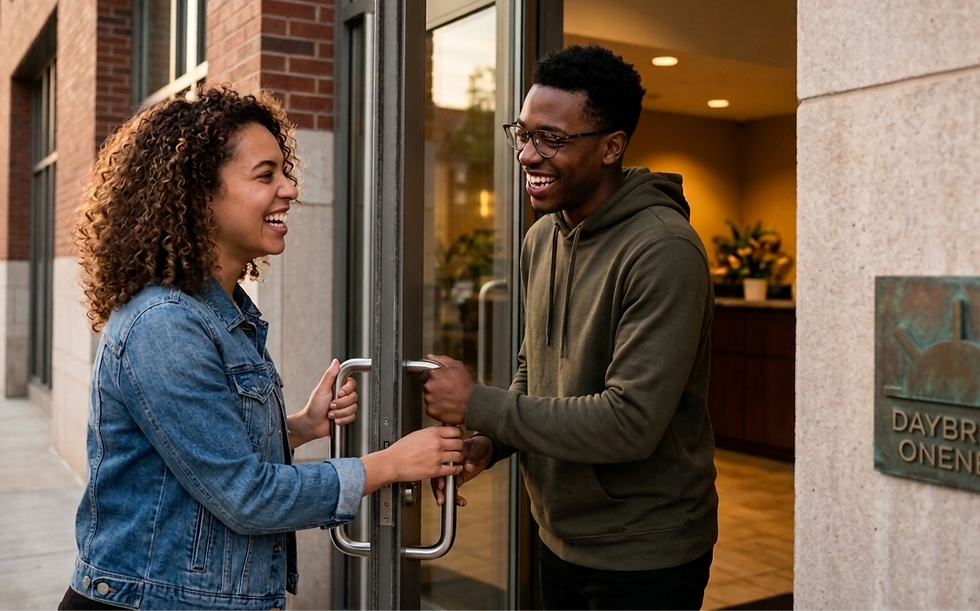
Think of the friend who shows up. The one who is simply there. The person who saves you a seat before you arrive. The person who notices you have been quiet for a few weeks and asks about it. The one who sits with you in a hard stretch with
out needing you to feel better on any particular schedule, and without needing the conversation to arrive anywhere.
Most of us can name that person, or at least we can remember a time when someone was that for us. We tend to file them under the good things in our life, somewhere alongside a job we like or a home we are fond of. What I want to suggest is that this is a serious underestimation. That friend is not a pleasant addition to the spiritual life. That friend is the spiritual life.
We've been sold a lie about awakening
Most of us inherit a picture of spiritual practice that looks solitary.
The lone meditator on a cushion. The hermit who goes up the mountain and comes back down changed. The monk in a quiet room. Even the modern version has the same shape: mindfulness as something you do privately, with headphones and an app, in the only ten minutes of the day when nobody needs anything from you. Whatever else those images say, they agree on one thing. The real work happens alone, and other people are, at best, a distraction from it.
That picture runs deep, and it seems humble enough. Underneath it, though, is a quiet assumption I'm not on board with: it draws a line between my awakening and yours. It suggests I could get somewhere spiritually while you stayed exactly where you are, and that the two facts would have nothing to do with each other.
Not half. The whole.
There is a story in the Pali Canon that I keep returning to.
Ananda was the Buddha's cousin and his attendant, the person who walked beside him for decades and heard more of his teaching than anyone else alive. If anyone knew the Buddha as a person, it was Ananda.
One day the two of them were staying in a town among the Sakyan people, and Ananda came to him with something he had been turning over for a while. He had noticed how much of the path seemed to depend on the people you walk it with: on good companions, on friends, on the community that surrounds a practitioner and holds them steady. He offered his conclusion almost as a gift, the way you do when you have worked something out and feel good about it. Surely, he said, this friendship is half of the holy life.
It is a generous thing to say. Half is a lot. Half means the people around you matter as much as everything else combined.
But the Buddha stopped him:
"Say not so, Ananda, say not so! It is not half of the holy life. It is the whole of the holy life." (Upaddha Sutta, SN 45.2)
Not half. The whole thing.
Let's think about what that actually claims. The path does not contain friendship as one useful ingredient among many. The path is friendship. We do not awaken alongside our friends, each of us privately working on ourselves in the same room. We awaken through them.
That should not be so surprising, though it usually is. Almost nothing we understand about ourselves arrived on its own. Our worst habits become visible to us because someone loved us enough to say something. Our patience gets built by the people who test it. Grief teaches us because it is grief over someone. The illusion of a separate self was actually assembled, piece by piece, out of relationships with other people. There is no version of any of us that arrived here alone, and therefore there is no version that awakens alone either.
A Sangha, then, is not an accessory to practice. It is not a nice place to go and do the real work in good company. It is the form the practice takes.
Where this led me
If friendship is the whole of the path, then it matters a great deal whether people can find it. Friendship of this kind needs somewhere to happen: somewhere to gather, to return to, and to last.
Rev. Gyomay Kubose wrote:
"I have always dreamed of establishing an American Buddhism . . . a uniquely American Buddhism that could be easily understood and practiced by Americans and that would contribute to American life and culture. This Buddhism can be explained in simple, everyday language and practiced in every aspect of our daily life. Yet, it is a unique Buddhist life-way, non-dichotomized and non-dualistic, that will bring about a peaceful, meaningful, creative life, both individually and collectively."
A dream like that cannot live only in a book. It needs places. In most cities and towns across North America, one of two things is true:
Either there is no Buddhist temple or center at all, or the one that exists is difficult for a newcomer to enter. Sometimes it feels like there is a knowledge level that is assumed in order to take part. Sometimes it primarily serves a particular community and holds its services in a language a newcomer does not speak. That is a good and necessary thing for the community it serves, but it is simply not accessible for people outside of that community.
For a great many people who are looking for somewhere they can walk in, be welcomed, and immediately feel comfortable, there is nowhere to go.
That is the part I keep thinking about.
What this means for us
Daybreak found each other on a screen during the pandemic, and later some of us began gathering at a coffee shop in Apex. I want to say clearly how grateful we are to The Mocha Room. They have been genuinely good to us, they have made room for us, and we will keep enjoying our time there as we work toward something of our own.
A rented location can only do so much, though.
Here is what I mean, practically. We meet every other Monday evening. If you cannot make a Monday, or something comes up that week, you are down to seeing us once that month. If Monday evenings do not work with your schedule or your job at all, then in-person Daybreak is not really available to you. We cannot offer a service at a different time of day. We cannot hold a class on a Wednesday or a meditation group on a Saturday morning. We split the statue of Amida Buddha into 3 pieces and wrap them in bubble wrap after every single time we meet. When someone is struggling on a Thursday and needs a quiet place to sit, or a person to talk to, we have nowhere to tell them to come.
A permanent place changes what we are able to be for people. It could hold weddings and funerals and the family celebrations that people want a spiritual home for. Retreats. Community festivals. Classes at more than one time of day. A small bookstore. Most of all, perhaps, it could be a reflective space that is simply open, where anyone could come in for a moment of peace, or sit down and have a real conversation with a good friend.
So I have begun to dream about a home of our own.
I want to be honest that this is my dream at the moment, mine and Kelli's, and that I am writing this in part to find out what you think of it. Some of you may be thinking that what we have now works perfectly well. For many of us it does. That is a fair thing to think, and I am not trying to talk anyone out of it. This is also not about being bigger for the sake of being bigger. My concern is about the people still searching, who we cannot welcome into a space we do not have.
There is nothing to decide today and nothing being asked of you. I wanted you to hear where my thinking is going, and I would like very much to hear yours.
For those of us who practice from a distance
I want to say this clearly:
Daybreak began online. That is not our overflow or our lesser half. It is our origin, and for many of us it is still the whole of how we gather. A home in Apex would not shrink that circle or move anyone to the edge of it. In fact, I think it would be the opposite.
Right now we are effectively two Sanghas that share a name. The online Sangha meets over Zoom every other Monday, and the in-person group meets at The Mocha Room on the Mondays in between. There is no way for the two to be in the same room, because there is no room. A shared space cannot support the equipment - we have 15 minutes to set up and break down everything we use every time we meet.
A permanent space would let us do something we have never been able to do: cameras and screens to create a hybrid meeting. Those joining from a distance would be present in the meeting rather than attending a separate one, and those of us in Apex would be able to see and hear you. Our online Sangha Directors could give talks that the in-person group receives, so the teaching would flow in both directions. We could welcome in guest speakers from other Sanghas that could join remotely. That would be new. One Sangha, gathering in more than one way.
I hope this would be a beginning rather than an ending. Groups like ours are rare and that needs to change. I would love for a home here to be something other communities could look at and think that they could do it too. If you practice from another city and want to help build a group near you, we can help support that.
No one's place in this Sangha depends on a building. Not now, not ever.
The whole of it
A building is never the point of the journey. It is what helps make the journey, and the friendship, and the welcome possible.
Because the friend who shows up, that is the whole of it. That is the whole path.
This is what we mean by Oneness: no one awakens alone.
If you have thoughts, questions, hopes, or hesitations about any of this, I would really like to hear them. Reply here, find me at a meeting, or email me at ichiyo@daybreakoneness.org.
Until next time.
Josh Ichiyo


Comments